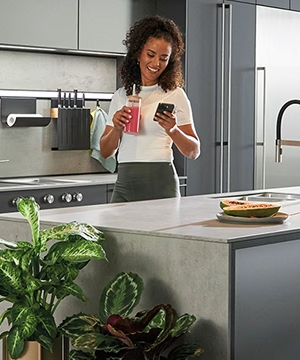
Homes across the world are evolving, and kitchens are leading that transformation through smarter layouts inspired by kitchen designs 2026. In modern households, the kitchen is no longer considered a utility-focused and closed area. Rather, it has been turned into a hub of cooking, storing, communicating, and even working. Families spend a lot of time in kitchens, and this implies that the space should be comfortable, efficient, and flexible. Due to the evolving lifestyle, kitchens have to keep up with the changes without sacrificing aesthetics or functionality. This shift has made modular culinary workflows a defining feature of next-generation kitchen planning, where adaptability matters as much as appearance.
How Modular Thinking Is Redefining Modern Kitchens
Modularity is a concept that has expanded rapidly due to the demand from homeowners who demand flexible solutions that are shaped by European kitchens. Conventional fixed designs tend to restrict the potential of the kitchen’s use over time. Modular thinking changes this by bringing in units that can be substituted and modified when the needs vary. Cabinets, counters and storage systems are designed in such a way that they work as a unit even though they function independently. This allows easy, partial replacement or layout changes without having to carry out major renovations. Consequently, kitchens will be more practical, efficient and future-proof, making them closer to real-life usage instead of strict design rules.
These Are the Key Shifts Shaping Modular Culinary Workflows
- Zone-Based Kitchen Planning
One major shift in kitchen designs 2026 is the clear division of the kitchen into functional zones. The areas of cooking, washing, preparation, storage, and serving are now planned independently, yet connected logically. Such a solution will minimize the undue flow of movement and avoid congestion during rush times. For instance food preparation is done near the storage area, whereas cooking areas are designed near the ventilation. Modular zoning also enables several individuals to cook comfortably in the same kitchen, thus making communal cooking smooth and less stressful.
- Flexible Cabinet and Storage Modules
Leading European kitchen suppliers emphasize modular storage systems, which easily adapt to changing demands. The kitchens have been transformed into adjustable racks, pull-out drawers, rotating corner units, and removable organizers instead of the fixed shelves. These features enable house owners to rearrange storage as their cooking habits evolve. In growing families or compact apartments, flexible cabinetry ensures efficient storage and better accessibility. This flexibility enhances the day-to-day operations and minimizes the clutter in the system.
- Interchangeable Work Surfaces
Modern kitchens shaped by European kitchens are no longer subjected to fixed elements such as worktops. Modular designs permit exchanging surfaces based on their use; i.e. repurposing, extending, or swapping. A prep counter can be used as a serving space, and an island can be extended to have gathering and retract to be used in day-to-day activities. Multitasking can be carried out using mobile workstations and layered surfaces that do not congest the space. This convenience boosts everyday cooking habits, and it simplifies entertainment
- Appliance Integration for Seamless Workflow
The second advantage of the innovative kitchen designs 2026 is the incorporation of appliances in the modular designs. Inbuilt ovens, hidden dishwashers and hidden fridges continue to give a visual flow throughout the kitchen. The arrangement of the appliances is done in such a way that the movements are minimized between zones. As an example, dishwashers are located near storage, which enhances efficiency. This considerate design translates to kitchens which look to be in order, relaxed, and easy to operate.
- Compact Modules for Urban Living
Due to an increase in the density of cities, European kitchen suppliers are working on modular solutions, namely those meant to be used in smaller homes. Small modules tend to include several features, e.g. seating with storage or prep areas with inbuilt appliances. Vertical storage and skinny profile units do not give the impression that the kitchen is congested. The designs enable urban homeowners to experience maximum functionality despite having limited spaces, which proves that size does not have to be a limitation to performance.
- Customizable Layouts for Changing Lifestyles
One of the strong points of a developed European kitchen company is the possibility of customizing layouts over time. Homeowners can create a modular kitchen that could be modified according to family size, lifestyles, and needs. It is possible to add and remove units and rearrange them without having to break down the whole kitchen. This flexibility supports long-term usability and reduces renovation costs, making kitchens more sustainable investments.
Conclusion
The future of kitchen planning is built around flexibility, efficiency, and thoughtful design rooted in European kitchens. Modular kitchen systems enable homeowners to design spaces to suit the real-life requirements and remain simple and chic. With the development of kitchen designs 2026, one thing that will remain central is designing the kitchen that will be smarter, more durable, and feel effortlessly modern.